HVO price in 2026: what it really costs in TCO ?
In 2026, HVO's real cost is a TCO question, not a per-liter one: carbon taxes, fuel savings and tender wins change the calculation.

Why the per-liter price does not tell the whole story
Comparing HVO and fossil diesel purely on their per-liter price is a strategic mistake in 2026. That approach overlooks two structural realities: the upward trajectory of carbon taxation on fossil fuel, and the operational gains HVO delivers across its use in a fleet.
A fleet manager or fuel buyer who decides based solely on the price shown at purchase risks underestimating the real cost of fossil fuel and overestimating that of HVO. The right metric is Total Cost of Ownership (TCO): it factors in purchase price, taxation, consumption, maintenance and the commercial value of the fuel used.
In 2026, as carbon pricing mechanisms gain traction, the gap between sticker price and real cost becomes a financial management issue, not just an environmental one. This article breaks that gap down step by step.
The hidden cost of fossil diesel
Fossil diesel carries a structural cost that is not always visible at the pump: rising carbon pricing. The ETS2 mechanism, driven by the European Union, will progressively extend the paid-emission-quota principle to fuels used in road transport.
Every tonne of CO2 emitted by burning fossil diesel now carries a price set to rise, turning carbon taxation into a central variable in a fleet's profitability calculation.
For a fuel buyer, this means the price of fossil diesel is not fixed: it includes a tax component that will weigh increasingly heavily in the coming years. By contrast, HVO, as a renewable fuel, largely escapes this carbon surcharge dynamic.
Ignoring this trajectory means building a fuel budget on an assumption of price stability that no longer matches European regulatory reality. Finance teams managing multi-year TCO must now treat this fiscal component as a structural cost line, not a temporary one.
The real TCO of HVO
HVO's TCO rests on several levers that, combined, meaningfully shift the economics compared with fossil diesel. The first lever is technical: HVO has a cetane index above 70, versus roughly 51 for conventional fossil diesel. That superior combustion quality translates into better engine energy efficiency.
In practice, this improved combustion delivers fuel savings estimated at 2 to 5 percent depending on usage conditions and fleet type. Across a fleet of dozens of vehicles, this differential translates into fuel savings that are directly measurable on the annual bill.
The second lever concerns maintenance. A cleaner-burning fuel reduces particulate filter (DPF) fouling and limits certain demands on the AdBlue system, which can ease the frequency and cost of maintenance operations, based on feedback from manufacturers such as Volvo Trucks.
The third lever, often underestimated, is commercial and competitive. Using HVO supports a credible CSR narrative with clients, but more importantly allows a fleet to score positively on the environmental criteria now embedded in a growing share of public and private tenders.
- Fuel consumption: estimated 2 to 5 percent savings thanks to a cetane index above 70
- Maintenance: less DPF fouling and reduced AdBlue system demand
- Taxation: limited exposure to the upward ETS2 trajectory
- Image and CSR: a credible argument with clients and stakeholders
- Tenders: an environmental criterion increasingly decisive for being shortlisted
This last point deserves emphasis: in many sectors, being unable to demonstrate a fleet decarbonization path now means losing contracts before commercial negotiations even begin. HVO thus becomes a competitiveness tool, not merely an environmental choice.
How to optimize your HVO purchase price
Once TCO is understood, the next question becomes how to secure the best possible purchase price over time. The HVO market remains marked by some volatility, tied to feedstock supply and the still-young structure of the European supply chain, as regularly documented in market reports from the European Biodiesel Board.
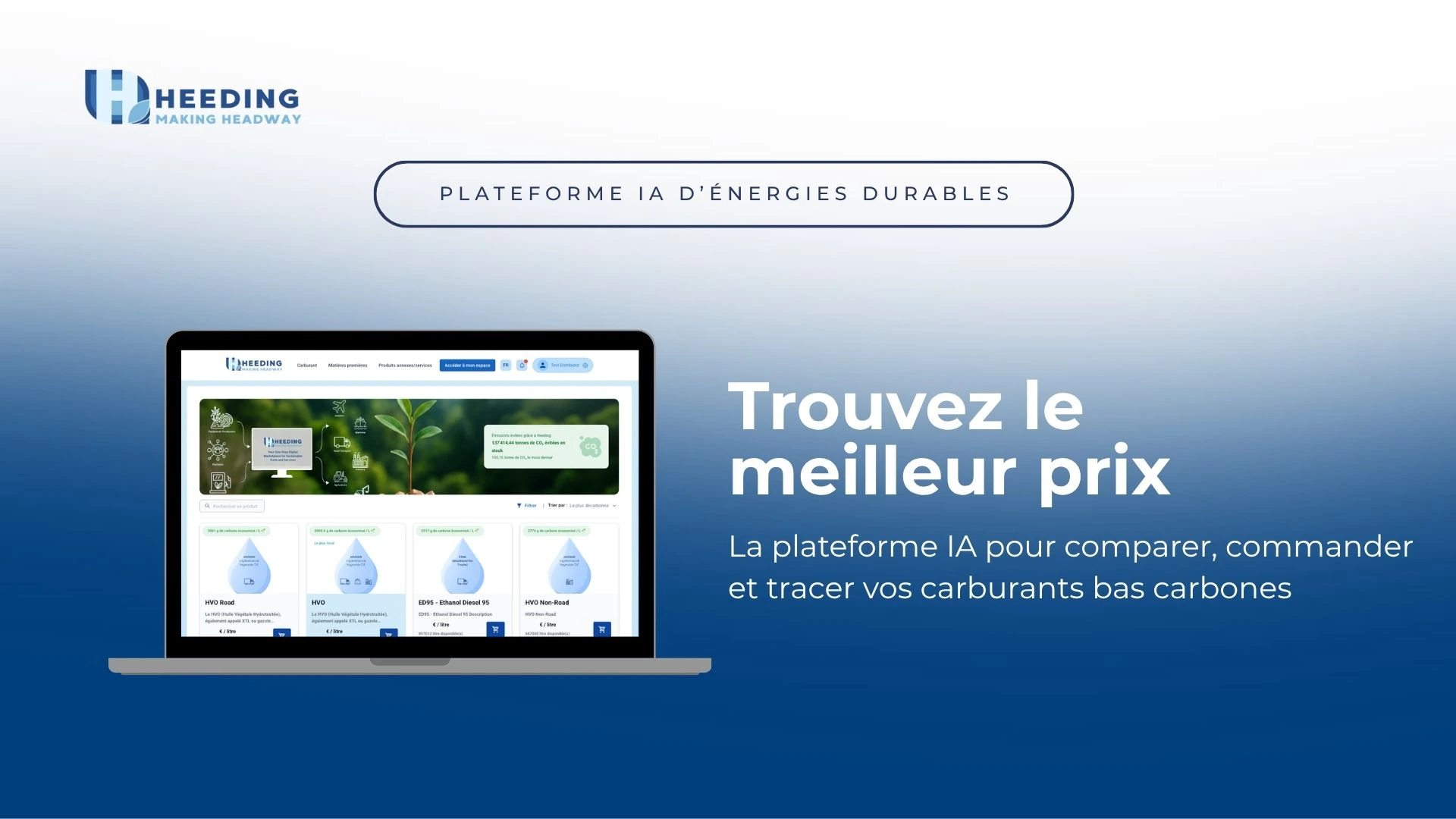
In the face of this volatility, the solution is to use digital platforms that connect buyers directly with producers or distributors. By reducing the number of intermediaries, these platforms limit the accumulation of successive markups and allow you to compare different suppliers to find the best price.