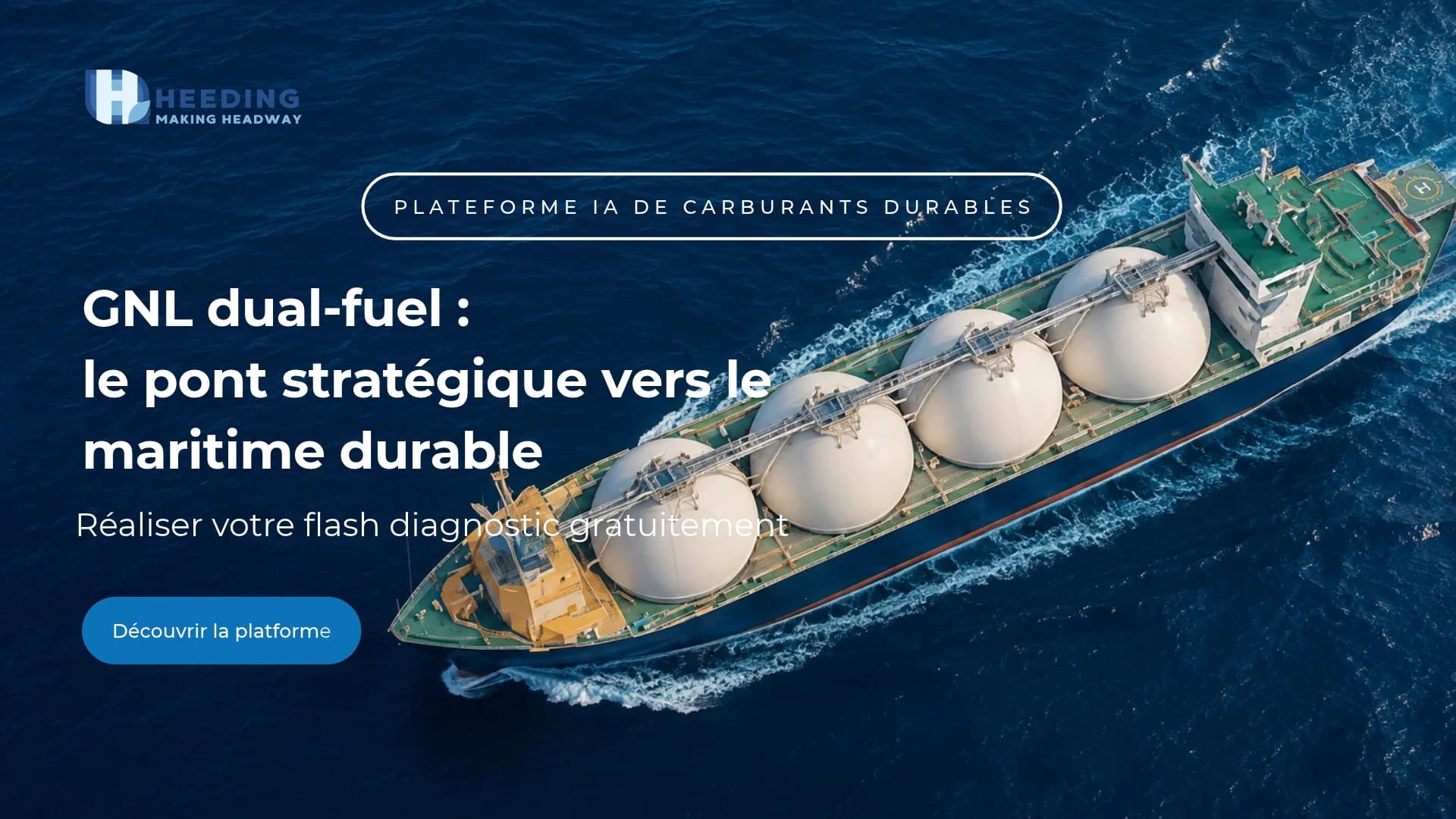
LNG dual-fuel: the strategic bridge to sustainable maritime fuels
LNG dual-fuel lets owners operate today while keeping a direct path open to Bio-LNG and e-methane, with no engine change required.
The owners' dilemma amid still-shifting regulation
In 2026, ship owners must commit to heavy capital investment while the maritime regulatory framework keeps evolving. FuelEU Maritime sets a trajectory for cutting carbon intensity, but the calculation methodologies, recognised emission factors and pace of certain thresholds remain subject to adjustment. Waiting for full clarity is not an option: the fleet has to decarbonise, and the propulsion choices made today will bind owners for fifteen to twenty-five years.
The risk is therefore not only regulatory, it is also technological. Betting on a single, still-immature alternative fuel pathway risks an industrial dead end if production fails to scale or standards shift. This is precisely the context in which LNG dual-fuel stands out as a pragmatic answer rather than a bet on fossil gas.
Why the LNG fleet already leads the market
Data published by DNV illustrates how far the sector has already moved. By this count, 929 LNG-fuelled vessels are currently in operation worldwide, roughly six times the combined fleet running on methanol or ethanol. That figure is not a footnote: it reflects a broad, converging choice made by very different owners, operating across varied routes and market segments.
The order book confirms this trend rather than reversing it. DNV records a further 663 LNG vessels on order, meaning owners keep selecting this propulsion fully aware of the alternatives on the table. This is not inertia: it is a decision made with a fifteen-to-twenty-five-year horizon in mind, at the very moment debates over tomorrow's fuels are at their most intense.
This choice is driven primarily by availability and industrial maturity. Dual-fuel engines are proven, the LNG bunkering network keeps expanding across major world ports, and crews and technical teams already have the necessary skills in place. Compared with methanol or hydrogen pathways still in early deployment, LNG offers a solid, immediately usable operational base.
The strategic bridge concept: infrastructure built to last
One infrastructure, different molecules
The central argument for LNG dual-fuel is that it is a technological bridge, not a dead end. The engines, cryogenic tanks, bunkering systems and port infrastructure built today for fossil LNG are strictly identical to those needed for Bio-LNG, also known as LBM (Liquefied BioMethane), and for synthetic e-methane. This is not partial or theoretical compatibility: it is a complete molecular interchangeability.
No engine modification required
This is the most decisive point for a technical director: Bio-LNG and e-methane are drop-in fuels. A dual-fuel LNG engine installed in 2026 can run on Bio-LNG as soon as it becomes available on a given route, with no technical shutdown, no costly retrofit and no complex recertification. The investment in propulsion is therefore tied not to whether the molecule is fossil or renewable, but to its shared chemical composition.
Choosing LNG dual-fuel today secures the ability to switch to Bio-LNG and e-methane tomorrow, with no additional engine investment.
This logic reshapes the investment decision. An owner is not buying an 'LNG' engine, but a liquefied-methane propulsion capacity, whatever the molecule's origin. As Bio-LNG volumes grow on the European market, the existing fleet can absorb that ramp-up progressively, port by port and contract by contract, without waiting for a vessel renewal cycle.
Compliance, traceability and performance with Bio-LNG and marine HVO
Bio-LNG and marine HVO are not marketing add-ons: they are the most direct compliance lever for dual-fuel LNG vessels facing carbon-reduction trajectories. Bio-LNG is produced from purified, liquefied biomethane sourced from organic waste or agricultural residues, then fed into the same logistics chain as fossil LNG. Marine HVO can complement the strategy on segments or vessels that do not yet have direct access to Bio-LNG.
On emissions, the stakes are documented within existing European regulatory frameworks. Using Bio-LNG can achieve up to a 90% reduction in GHG emissions (depending on the feedstock used and the calculation methodology under the RED II / RED III directives), making it one of the most powerful carbon-performance levers available for maritime transport, with no modification to existing propulsion.
Traceability is the other pillar of this strategy. Sustainability certificates attached to Bio-LNG and marine HVO document precisely the feedstock origin, the real carbon footprint and compliance with sustainability criteria, a central issue given the rising reporting requirements across the sector. For a technical director, this traceability turns a fuel choice into a measurable, auditable compliance asset.
Building a competitive edge starting today
LNG dual-fuel offers what few other pathways can guarantee in 2026: immediate availability combined with a credible route to zero carbon, without relying on a still-uncertain technology bet. By securing propulsion compatible with Bio-LNG and e-methane now, owners gain the flexibility to adjust their fuel mix at the real pace of the market and regulation, rather than being dictated by either.
Heeding supports ship owners and fleet managers through this strategy, from compliance analysis to sourcing traceable Bio-LNG and marine HVO.
Assess the maturity of your maritime decarbonisation strategy with the Heeding Flash Diagnostic: https://tools.myheeding.com/diagnostics