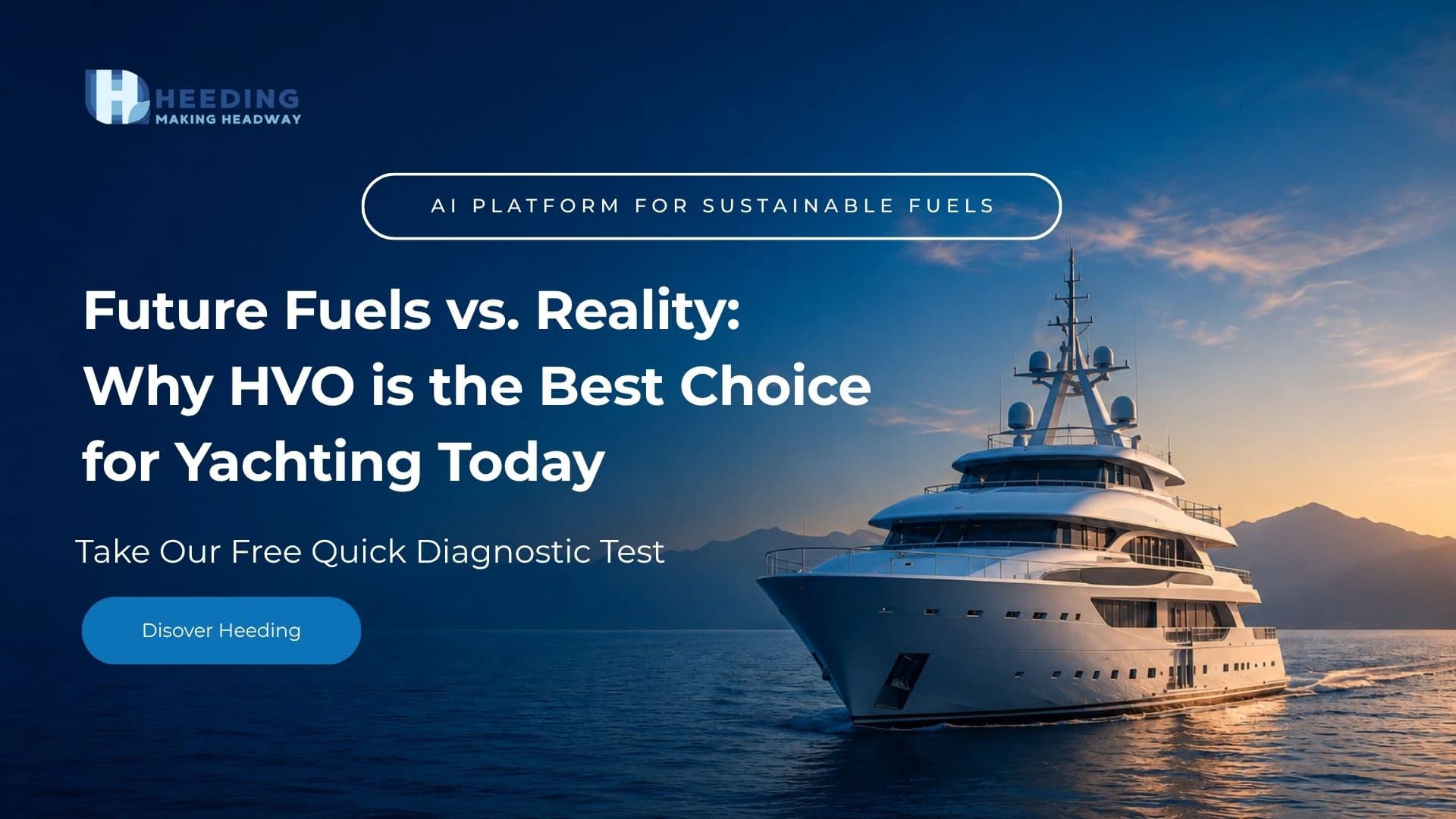
Future fuels versus operational reality: why HVO is the right call for yachting today
Methanol, hydrogen and ammonia dominate the headlines, yet remain out of reach for most fleets. HVO cuts emissions right now, without any engine modification.
The backdrop: the rush toward tomorrow's fuels
Over the past few years, the maritime sector has been swept up in enthusiasm for alternative fuels. Major shipowners, as publicly announced by Maersk, have announced vessel orders designed to run on green methanol. Hydrogen and ammonia now feature prominently in decarbonisation roadmaps presented at industry trade shows and in corporate communications.
This momentum is understandable: emission-reduction targets set by the International Maritime Organization and by European regulation, notably the FuelEU Maritime framework, demand a deep transformation of bunkering practices. But between the announcement of a prototype and the operational availability of a fuel for an existing fleet of yachts or commercial vessels, there is a gap that few articles bother to measure.
The reality on the ground: technologies still in the making
Green methanol requires dedicated tanks, adapted or retrofitted engines, and a bunkering network that remains embryonic outside a handful of pioneering hubs. Hydrogen brings cryogenic or high-pressure storage challenges, complex bunkering procedures, and production costs that remain high relative to limited availability. Ammonia compounds the difficulties further: crew toxicity risks, the need for specialised storage, and almost no commercial-scale track record to date.
For a shipowner, a captain or a yacht fleet manager, these constraints are far from minor technical details: they translate into port calls restricted to equipped facilities, meaningful operational risk, and capital investments that simply cannot be justified for most vessels currently in service.
HVO: a solution available right now
HVO (Hydrotreated Vegetable Oil) stands out for a quality that is rare among sustainable fuels: it is a genuine drop-in fuel. It can be used in existing diesel engines with no mechanical modification, and often without requiring new certification from the engine manufacturer.
- Full compatibility with current diesel engines, with no conversion or retrofit needed
- Bunkering infrastructure already available in a growing number of European ports
- Leduction of up to 90% in GHG emissions (depending on feedstock and RED II/III methodology
- No major investment required in new equipment or specialised crew training
- Can be blended with conventional marine gas oil, easing a gradual transition
For a yacht fleet that must stay operational on established routes, calling at ports that are not all equipped for tomorrow's fuels, this immediate availability changes the equation. HVO makes it possible to act on carbon footprint now, without waiting for infrastructure that does not yet exist everywhere.
Methanol, hydrogen, HVO: an unvarnished comparison
Green methanol offers genuine long-term decarbonisation potential and suits large container ships that can plan fixed routes around a few equipped ports. But for a yacht or a vessel with varied ports of call, dependence on a still-limited bunkering network is a major operational constraint, on top of the added cost of engine conversion.
Hydrogen promises near-zero emissions at point of use, but its volumetric energy density requires bulky tanks that fit poorly with yacht design, and its production cost remains prohibitive at current commercial scale. HVO, by contrast, does not deliver a complete emissions cut, but it delivers a substantial one immediately, with near-zero operational risk and no need to redesign the vessel.
The most virtuous fuel on paper is only useful if it is available dockside, compatible with the vessel's engine, and economically viable, here and now.
The winning strategy: act now, prepare for what's next
Pitting HVO against future fuels is something of a false debate. The real question is not choosing once and for all, but sequencing the transition intelligently: use HVO today to cut the carbon footprint of the operating fleet, while closely tracking the maturation of methanol, hydrogen or ammonia for future vessel renewals or newbuilds.
This pragmatic approach also helps meet regulatory requirements (as mandated by the European Commission through the FuelEU Maritime regulation, which imposes a progressive reduction in carbon intensity starting at -2% in 2025 )and stakeholder expectations, from owners to charterers to insurers, without waiting for infrastructure or technology that will only mature years from now for most frequented ports.
How Heeding supports your transition
Every fleet has its own reality: routes sailed, engine types, charter contracts, port constraints. Heeding helps owners, captains and fleet managers identify the fuel solution best suited to that reality, rather than to a technology promise that remains years away, and to structure a credible medium-term decarbonisation path.
To assess the real potential of HVO for your vessels, your first step can be a Flash Assessment : a quick analysis of your current fleet, routes, and supply constraints to identify where and how HVO can reduce your emissions today.