COMPATIBILITY01 / 03
Drop-in ready
Compatible with existing aircraft and aviation infrastructure — no adaptation required.

FUEL — AVIATION
Cut your emissions, meet regulations and integrate SAF without changing your operations.
SAF / pathway
DEFINITION
SAF (Sustainable Aviation Fuel) is a renewable jet fuel made from waste oils, residues, or synthesised from green hydrogen and CO₂. Blended up to 50% with fossil kerosene, it cuts lifecycle emissions by up to ~80%.
At a glance
BENEFITS
An immediate solution to decarbonize aviation.
Compatible with existing aircraft and aviation infrastructure — no adaptation required.
80%
Up to 80% lifecycle emissions reduction depending on the production pathway.
Meets ReFuelEU Aviation requirements and international sustainable-aviation standards.
WHY NOW
Why switch to this fuel right now
TRACEABILITY — EVERY BATCH
Access complete, verifiable and compliant documentation for every flow, from production to use.
Full traceability of your fuelCOMPLIANCE
Heeding automates the EU and French rules tied to this fuel — verified and kept current.
Most relevant for
Compare, secure and trace your supply from a single platform.
Discover the platform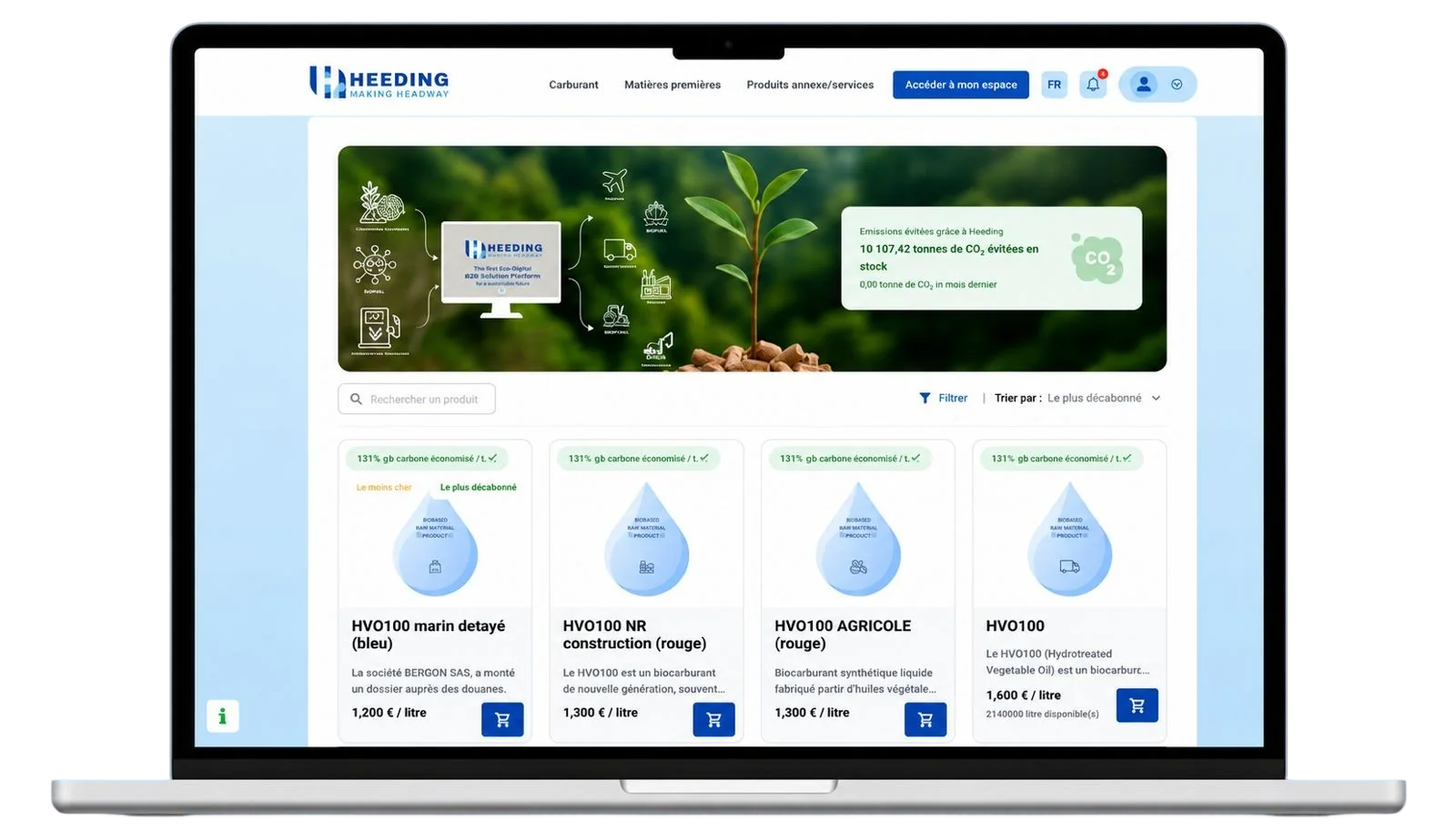
TECHNOLOGIES
Compare and choose the SAF that fits best
Converts renewable electricity into synfuel through electrolysis, then combines it with CO₂ to create synthetic fuels for aviation.
Produced from renewable energy to make hydrogen, then synthesized with CO₂. Usable directly in existing engines.
Produced by hydrotreating fats and oils into synthetic kerosene. Blendable with conventional kerosene.
Produced via Fischer-Tropsch synthesis, converting biomass or other carbon sources into high-quality synthetic hydrocarbons.
PERSONALIZED DIAGNOSTIC
Answer a few questions and discover the most relevant options for your usage, constraints and goals.
Run the diagnostic
Here is your energy diagnostic
A personalized overview of your situation and the solutions best suited to your profile.
YOUR PROFILE SUMMARY
YOUR PRIORITIES
EXECUTIVE SUMMARY
This 50-vehicle fleet runs on B7 diesel — close to 3,300 tCO₂e per year. Phasing in XTL (HVO) and B100 cuts emissions without taking vehicles off the road.
CURRENT ANNUAL COST
ESTIMATED ANNUAL COST
ANNUAL SAVINGS
SAVINGS
COMPLIANCE OVERVIEW
YOUR TRAJECTORY(7-YEAR OUTLOOK)
Status quo — B7 diesel
Level band: 0–10%
€12.95 M
Reference
Level II target band (10–25%) — XTL (HVO)
Level band: 10–25%
€13.4 M
+€0.45 M (net premium)
Stretch Level III band (25–50%) — XTL (HVO)
Level band: 25–50%
€14.1 M
+€1.15 M (net premium)
Up to 90% less CO₂e with the right fuel
Learn moreNEXT STEPS (PER SEGMENT)
Tractor units — DAF XF 480
Current: B7 diesel
1.05 M L / year
Next step
XTL (HVO100)
≈2.5 kt CO₂e avoided / yr
Rigids — Volvo FH
Current: B7 diesel
200,000 L / year
Next step
B100 (FAME)
≈320 t CO₂e avoided / yr
Illustrative example — indicative figures. Run the diagnostic for your real data.
FAQ
Not yet: ASTM D7566 currently limits blending to 50% maximum for today’s pathways.
ReFuelEU Aviation mandates 2% in 2025, 6% by 2030, 20% by 2035, up to 70% by 2050 in jet fuel at EU airports.
We use cookies and similar technologies for analytics and functionality. See our Cookie Policy.